

Subthalamic nucleus shows opposite functional connectivity pattern in Huntington’s and Parkinson’s disease
Any further question? Gwenaëlle Douaud (Oxford FMRIB Centre, Wellcome Centre for Integrative Neuroimaging)
Abstract
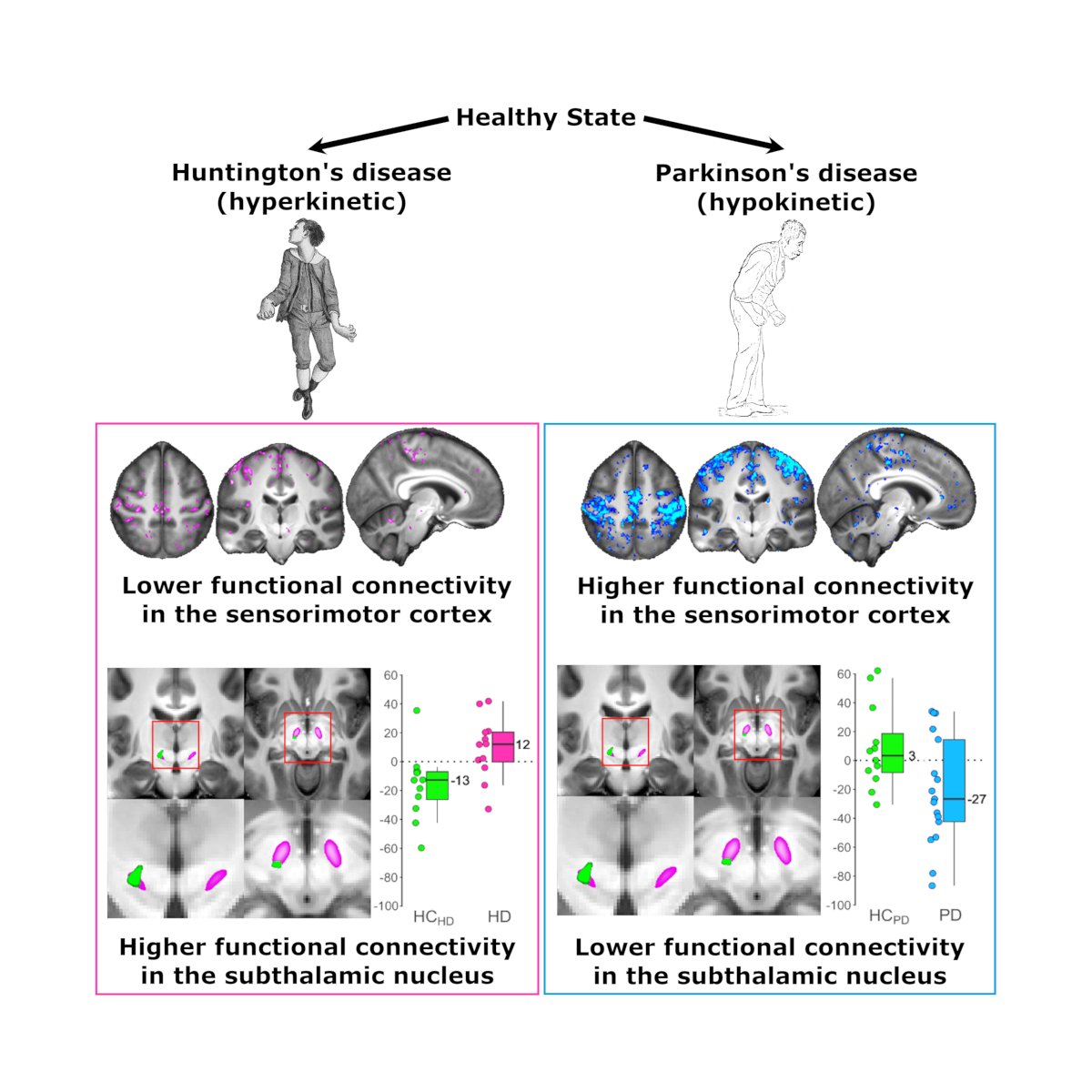
Huntington’s and Parkinson’s disease (HD, PD) are two movement disorders representing mainly opposite states of basal ganglia inhibitory function. Despite being an integral part of the cortico-subcortico-cortical circuitry, the subthalamic nucleus’ (STN) function has been studied at the level of detail required to isolate its signal only through invasive studies in HD and PD. Here, we tested whether the STN exhibited opposite functional signatures in early HD and PD. We included both movement disorders in the same whole-brain imaging study, and leveraged ultra-high field 7T MRI to achieve the very fine resolution needed to investigate the smallest of the basal ganglia nuclei. Eleven of the 12 HD carriers were recruited at a premanifest stage, while 16 of the 18 PD patients only exhibited unilateral motor symptoms (15 were at Stage I of Hoehn and Yahr off medication).
Our group comparison interaction analyses, including 24 healthy controls, revealed a differential effect of HD and PD on the functional connectivity of the STN within the sensorimotor network, i.e. an opposite effect compared with their respective age-matched healthy control groups. This differential impact in the STN included an area precisely corresponding to the deep brain stimulation “sweet spot” – the area with maximum overall efficacy – in PD. Importantly, the severity of deviation away from controls’ resting-state values in the STN was associated with the severity of motor and cognitive symptoms in both disease, despite functional connectivity going in opposite directions in each disorder. We also observed an altered, opposite impact of HD and PD on functional connectivity within the sensorimotor cortex, once again with relevant associations with clinical symptoms. The high resolution offered by the 7T scanner has thus made it possible to explore the complex interplay between the disease effects and their contribution on the STN, and sensorimotor cortex. Taken altogether, these findings reveal for the first time non-invasively in humans a differential, clinically meaningful impact of the pathophysiological process of these two movement disorders on the overall sensorimotor functional connection of the STN and sensorimotor cortex.
– Evangelisti, Boessenkool et al., Brain Communications 2023
Results, Design and Image Files
- Dual Regression
- Dual Regression Template
- Dual Regression Input 4D file
- Dual Regression Outputs
- Individual ROIs
- Templates For Registration/Visualisation